
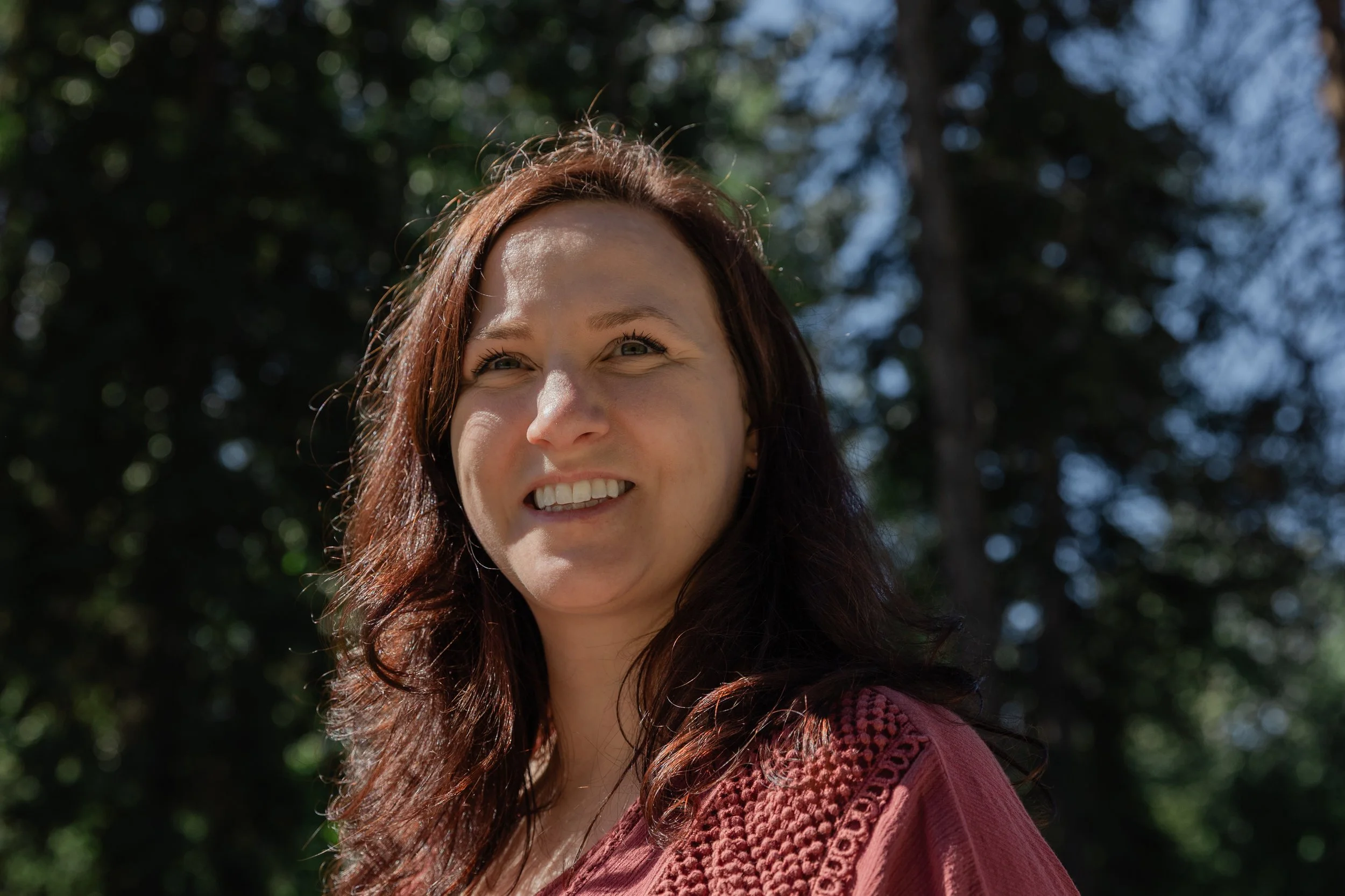
I am a Registered Clinical Counsellor (RCC) with a Master of Arts in Counselling Psychology. My approach to counselling is warm, curious, and collaborative, with a focus on understanding the experiences and relationships that shape how we move through the world.
I work with individuals and couples who may be feeling stuck in patterns that are difficult to change, navigating relationship challenges, or trying to better understand themselves and their emotions. I believe curiosity is an important part of this work, and I approach counselling with openness and without judgement.
My clinical practice is attachment-focused, relational, and integrative. My training in Emotionally Focused Individual Therapy (EFIT), Emotionally Focused Couples Therapy (EFCT), and EMDR informs my work, alongside a trauma-informed approach. I draw from these frameworks based on the needs of the person or relationship in front of me.
You bring your own experiences, knowledge, and understanding of yourself, while I bring clinical training, curiosity, and a different perspective. I hope to create a space where you can be genuine, explore what matters to you, and work toward changes that feel meaningful.
Hi, I am Jamie
Who I Work Best With
I work with adults and couples who are navigating challenges in their relationships, their sense of self, or their day-to-day lives. For individuals, this may include anxiety, self-worth and identity concerns, people-pleasing and boundaries, perfectionism, emotional overwhelm, life transitions, or difficult past experiences. I also work with people who may not have a clear name for what they are experiencing, but know that something feels off or that they would like things to feel different.
With couples, I work with partners who want to feel closer but find themselves struggling with conflict, distance, or feeling misunderstood. Sometimes there is a particular issue bringing you to counselling, while other times it may simply feel like you have lost some of the connection you once had and are not sure how to find your way back to it.
I work best with people who appreciate warmth, honesty, and a little directness. I approach difficult conversations with care, but I also believe that sometimes the most helpful thing I can do is gently say what I am noticing. You do not need to know exactly what you need before reaching out. We can begin with where you are.
My Approach
I see counselling as a place to slow things down and make room for a fuller understanding of what is happening. Our experiences do not happen in isolation, and I think it can be helpful to consider the relationships, experiences, and circumstances that have shaped us.
I believe that difficult emotions and ways of responding often make sense when we understand them in context. Rather than simply trying to change or get rid of what feels difficult, I want to understand it with you and consider what might be helpful moving forward.
My work is informed by attachment, emotion-focused, and trauma-informed perspectives. I draw from different therapeutic approaches depending on the person or relationship in front of me, rather than following a one-size-fits-all formula. I want our work to feel thoughtful and purposeful, while still leaving room for flexibility, humour, and the realities of being human.
-
Attachment-based therapy explores how our early experiences and relationships can shape the ways we understand ourselves, connect with others, and respond to closeness, conflict, and emotional needs. Exploring these patterns can help create greater awareness and new possibilities for connection.
-
EFIT focuses on emotions as an important source of information about our needs, experiences, and relationships. Therapy can help you become more aware of emotional patterns, work through difficult emotions, and develop new ways of responding to yourself and the world around you.
-
EFCT focuses on the relationship patterns that couples can become caught in. Rather than seeing one partner as the problem, we explore the cycle between partners and the underlying emotions and needs that drive it. The goal is to support greater understanding, responsiveness, and secure connection.
-
EMDR, or Eye Movement Desensitization and Reprocessing, is a trauma-focused approach that can help people process distressing experiences that continue to affect them in the present. I integrate EMDR into individual therapy when it is appropriate for the client, their needs, and their goals.
-
Narrative Therapy explores the stories we develop about ourselves, our relationships, and our experiences. Together, we can examine the beliefs and meanings that have shaped these stories, make space for perspectives that may have been overlooked, and explore new ways of understanding yourself and your experiences.
-
Gestalt Therapy emphasizes awareness of your present experience, including your emotions, thoughts, body sensations, and ways of relating to others. It can help bring greater awareness to patterns that may be happening in the moment and create opportunities to explore new ways of responding and connecting.
Education & Training
Master of Arts in Counselling Psychology | Yorkville University
Bachelor of Science in Human Nutrition |St. Francis Xavier University
EMDR Basic Training | EMDR Consulting (EMDRIA Approved)
Emotion Focused Couples Therapy (EFCT) Externship | ICEEFT
Emotion Focused Individual Therapy (EFIT) Essentials | ICEEFT
Crisis Line Responder Training | CMHA
Background
My path to counselling has taken a few turns along the way. I earned my Bachelor of Science in Human Nutrition at St. Francis Xavier University in Nova Scotia, where I also worked as a skating coach. I loved the combination of teaching, connecting with people, and finding different ways to help someone approach something that felt challenging.
After graduation, I followed my curiosity west to Kimberley, British Columbia, where I spent several years working in tourism, forestry, and recreation. These experiences brought me into contact with people from many different backgrounds and walks of life, and gave me the chance to learn from all kinds of people and perspectives.
Along the way, I began to notice how often people would share pieces of their lives with me. Sometimes it was a personal story shared in passing, and sometimes a conversation would unexpectedly become something much more meaningful. I appreciated being someone people felt comfortable opening up to, and over time, I found myself wanting to support people more intentionally. That eventually led me to pursue a Master of Arts in Counselling Psychology.
During my graduate training, I developed a particular interest in couples work. I became fascinated by how two people can deeply want connection with one another, yet somehow find themselves feeling further apart in the process. I was drawn to the idea that beneath the arguments, frustration, or distance, there can still be so much care for one another.